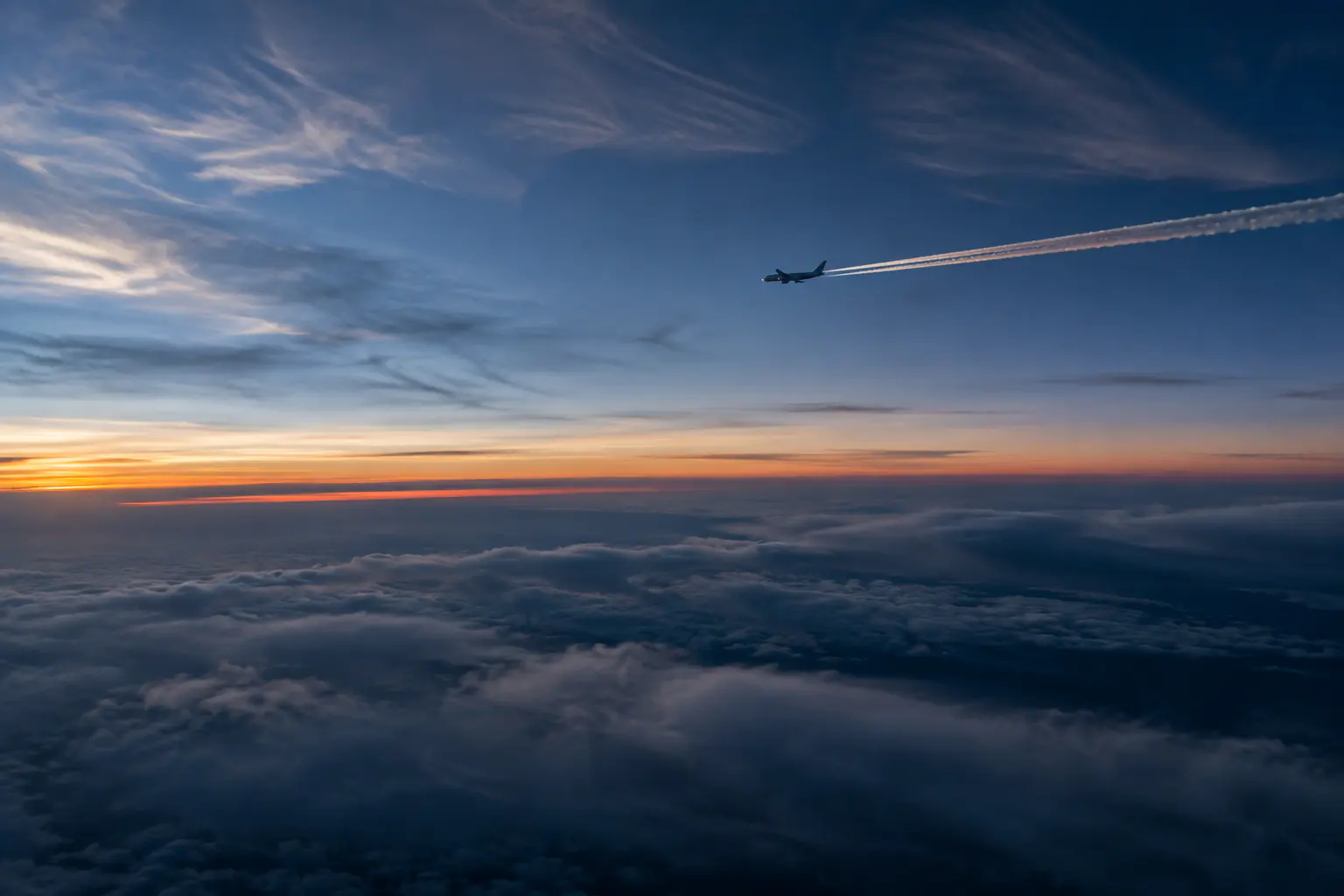
Some persistent contrails form only in cold, ice-supersaturated air, creating an opportunity to test small altitude changes.
Why only some trails persist
A visible trail can disappear quickly or spread into long-lived ice cloud depending on temperature and humidity at altitude. These narrow atmospheric regions are difficult to observe and forecast precisely, so models work with probabilities rather than certainties.
A small change can avoid a region
In suitable conditions, climbing or descending a few thousand feet may leave the ice-supersaturated layer. The maneuver must remain safe, compatible with air traffic control and efficient enough that additional carbon dioxide does not outweigh the expected benefit.
Evidence must guide deployment
Trials compare forecasts with satellite and aircraft observations, then measure fuel penalties and operational feasibility. The objective is not to eliminate every contrail but to prioritize situations with a credible, material climate benefit.
A forecast is a decision aid, not proof
Persistent contrails depend on atmospheric conditions along a specific path and altitude. Forecasts of those conditions contain uncertainty, and a changed route must still satisfy safety, fuel and traffic constraints. To evaluate a climate-aware routing claim, ask what conditions were predicted, what was actually flown and how the effect was measured afterward.
International Flight News separates verified facts, durable context and editorial analysis. Time-sensitive reports identify their primary sources, publication date and material updates.